
Powering Intelligence Sustainably: Why Clean Energy Will Define the AI Era
Powering Intelligence Sustainably: Why Clean Energy Will Define the AI Era
Artificial intelligence is reshaping the digital world. But behind
every model, every query, and every intelligent application lies something fundamentally physical: electricity.
For years, the technology industry has spoken about “the cloud” as if computing existed somewhere weightless and invisible.
Artificial intelligence is making the physical reality of computing impossible to ignore.
Behind every AI-generated answer, automated decision, image, video, recommendation, or prediction is a complex infrastructure of processors, servers, storage systems, cooling equipment, networks, and increasingly large data centers.
All of them consume energy.
And as AI moves from an emerging technology to a fundamental layer of the global economy, a critical question is becoming increasingly important:
Where will the electricity required to power the AI revolution come from?
The answer may shape not only the future of artificial intelligence, but also the future of the global energy system.
AI Is Digital. Its Energy Footprint Is Not.
Training advanced AI models requires significant computational power. Thousands of specialized processors may work continuously for weeks or months during the development of a large model.
But training is only part of the story.
Once deployed, AI models must respond to millions or billions of requests. This process, known as inference, requires electricity every time an AI system is used.
And AI usage is rapidly expanding beyond text generation.
AI is increasingly being integrated into:
- industrial automation,
- financial services,
- healthcare,
- transportation,
- robotics,
- software development,
- autonomous systems,
- smart cities,
- manufacturing,
- logistics,
- energy management,
- and billions of connected devices.
This means AI is evolving from a specialized digital service into a form of economic infrastructure.
The International Energy Agency estimates that global data centers consumed around 485 TWh of electricity in 2025. Its latest projections suggest that this figure could reach approximately 950 TWh by 2030. Electricity consumption from AI-focused data centers is expected to grow substantially faster, potentially tripling over the same period.
This creates a challenge that cannot be solved by computer science alone.
The AI revolution is also becoming an energy challenge.
The Most Important Question Is Not Only How Much Energy AI Uses
Discussions about AI and sustainability often focus on one metric:
How much electricity does artificial intelligence consume?
It is an important question—but an incomplete one.
A second question may ultimately matter even more:
How was that electricity produced?
Consider two data centers consuming exactly the same amount of electricity.
One operates primarily on electricity generated from high-carbon fossil fuels.
The other is supported by a portfolio of renewable and low-carbon energy sources.
Their computational output might be identical.
Their environmental impact is not.
This is why the future sustainability of artificial intelligence cannot be evaluated simply by counting kilowatt-hours.
We must also consider the carbon intensity of every kilowatt-hour.
As computing demand increases, expanding clean electricity generation becomes increasingly important.
In other words:
The AI transition and the clean-energy transition are becoming interconnected.
Clean Energy Is Becoming Digital Infrastructure
For much of the past two decades, renewable energy has primarily been discussed in the context of climate policy and environmental protection.
In the AI era, its role becomes broader.
Clean energy is becoming strategic infrastructure for the digital economy.
Data centers require enormous quantities of reliable electricity. More importantly, they require it continuously.
Servers do not stop operating when the sun sets.
Cloud services cannot simply pause when wind generation falls.
AI systems serving businesses, hospitals, financial institutions, factories, transportation networks, and consumers require power twenty-four hours a day.
This creates an important challenge.
Solar and wind are essential components of the clean-energy transition, but their production is inherently variable.
A resilient low-carbon power system therefore needs a combination of technologies:
Solar + Wind + Storage + Smart Grids + Dispatchable Clean Energy
And this is where technologies such as sustainable biomass and biogas can play an important role.
Why Biomass Has a Distinct Role in the Clean-Energy Mix
Solar and wind have transformed renewable electricity generation.
But biomass offers something different.
Properly designed bioenergy facilities can generate electricity when it is needed rather than only when weather conditions allow.
The International Energy Agency identifies this dispatchability as one of bioenergy’s important advantages. Biomass power can complement variable resources such as solar and wind while contributing to grid reliability.
That characteristic becomes particularly valuable in an economy increasingly dependent on data centers and other continuously operating digital infrastructure.
- Biomass can provide renewable power on demand
A sustainably operated biomass power plant can generate electricity regardless of whether the sun is shining or the wind is blowing.
This makes bioenergy potentially valuable as part of the renewable generation mix supporting high-availability infrastructure such as data centers.
The goal is not to replace solar or wind.
It is to complement them.
A future clean-energy system is unlikely to depend on a single technology. It will combine multiple sources whose characteristics balance one another.
- Energy can be recovered from materials that would otherwise become waste
Agricultural residues, forestry residues, certain organic wastes and other suitable biomass streams contain stored energy.
When managed responsibly, some of these materials can become part of a circular energy system instead of being discarded or left without productive use.
This creates an opportunity to connect three major economic challenges:
Waste management → Clean-energy production → Digital infrastructure
Rather than treating these sectors as separate problems, they can increasingly become part of the same circular economy.
- Biomass can contribute to local energy resilience
Unlike fuels that must be transported across long international supply chains, appropriate biomass resources can often be sourced regionally.
Local energy production can diversify electricity supply, create economic activity around feedstock collection and processing, and reduce dependence on a single source of generation.
For regions seeking to attract energy-intensive industries—including future AI infrastructure—availability of reliable local clean-energy resources may become an increasingly important competitive advantage.
- Biomass can help balance high levels of solar and wind
A power system dominated by variable renewable generation requires flexibility.
When solar generation declines in the evening or wind conditions change, another resource must compensate.
That flexibility can come from several technologies:
battery storage, hydropower, geothermal energy, demand response, grid interconnections—and dispatchable bioenergy.
Biogas systems in particular can be operated flexibly to match electricity demand and support grids with increasing shares of intermittent renewable generation.
The important point is not that biomass competes against other renewable technologies.
The greater opportunity is that these technologies work together.
Sustainability Matters: Not All Biomass Is Equal
For bioenergy to genuinely contribute to a lower-carbon AI economy, sustainability must be built into the entire value chain.
Calling a resource “renewable” is not enough.
Feedstock origin, land-use impacts, transportation distances, processing energy, combustion technology, ecosystem effects and lifecycle greenhouse-gas emissions all matter.
The strongest role for biomass is therefore associated with projects based on responsibly sourced feedstocks, particularly appropriate waste and residue streams, efficient conversion technologies and transparent lifecycle carbon accounting.
The IEA similarly stresses that bioenergy policy should promote sustainable supplies and carefully account for lifecycle greenhouse-gas emissions.
This distinction is essential.
The objective should not simply be to generate renewable electricity.
The objective should be to generate genuinely sustainable, low-carbon and reliable electricity.
AI and Clean Energy Have a Two-Way Relationship
There is another fascinating dimension to this transformation.
Clean energy can power artificial intelligence.
But artificial intelligence can also help build a better clean-energy system.
AI can analyze enormous volumes of information from power networks, weather systems, industrial facilities and energy markets.
This creates opportunities to improve:
- electricity-demand forecasting,
- renewable-generation forecasting,
- predictive maintenance,
- power-grid optimization,
- battery management,
- equipment fault detection,
- energy trading,
- industrial energy efficiency,
- dynamic load balancing,
- and demand-response systems.
The same technology creating new electricity demand can therefore also help make electricity systems more intelligent.
The relationship becomes circular:
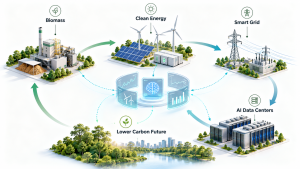
Clean Energy → Artificial Intelligence → Smarter Energy Systems → More Efficient Clean Energy
The International Energy Agency has highlighted this dual role: AI increases electricity demand through data centers, but can also help reduce costs, improve efficiency and support the transformation of the energy sector.
From Smart Grids to Carbon-Aware Computing
The connection between AI and energy may eventually become even deeper.
Today, most software applications behave as though electricity is unlimited and identical at every moment.
Future computing infrastructure may behave differently.
Imagine a data center capable of understanding the condition of the electricity grid in real time.
Some computing workloads must be performed immediately.
Others do not.
Non-urgent workloads could increasingly be scheduled for periods when renewable electricity is abundant.
AI systems themselves could decide:
- when a workload should run,
- where it should run,
- which data center should process it,
- when batteries should charge,
- when stored energy should be discharged,
- and when flexible generation should increase output.
This concept is often described as carbon-aware computing.
Instead of merely asking:
“Where is computing capacity available?”
future systems may increasingly ask:
“Where and when is the cleanest electricity available?”
That shift could fundamentally change the relationship between computing infrastructure and power generation.
Energy Efficiency Still Matters
Building more clean-energy generation cannot be the only answer.
AI itself must also become more energy-efficient.
The industry is already moving toward:
- more efficient processors,
- specialized AI accelerators,
- smaller domain-specific models,
- quantization,
- optimized inference engines,
- better cooling technologies,
- improved data-center design,
- and intelligent workload scheduling.
The IEA estimates that stronger efficiency improvements in hardware, software and infrastructure could substantially reduce future data-center electricity demand compared with less efficient growth scenarios.
The most sustainable future therefore combines two strategies:
Use less energy for every unit of intelligence.
And:
Generate the remaining energy as cleanly as possible.
These approaches are complementary, not competing.
The Data Center of the Future May Look More Like an Energy Ecosystem
As AI infrastructure expands, the boundary between the technology industry and the energy industry may gradually disappear.
A future AI data-center campus may combine several technologies:
Solar and wind providing large volumes of low-carbon electricity when conditions are favorable.
Battery storage handling short-duration fluctuations.
Sustainable biomass or biogas providing dispatchable renewable generation when required.
Smart grids connecting multiple generation and consumption sources.
AI-based energy management continuously optimizing the entire system.
In such an architecture, energy is no longer simply a utility purchased in the background.
It becomes part of the design of the computing infrastructure itself.
This is a profound change.
For decades, the technology sector optimized around three primary resources:
Compute. Storage. Network.
The AI era may require a fourth resource to be treated with equal importance:
Energy.
And increasingly:
Clean Energy.
The AI Boom Could Accelerate Investment in Clean Power
The rise of AI clearly creates challenges for electricity systems.
But it may also create an extraordinary opportunity.
Large, predictable electricity consumers can provide powerful economic incentives for new generation capacity.
The IEA expects renewable sources to play a major role in meeting additional electricity demand from data centers over the coming years.
This means the unprecedented investment flowing into artificial intelligence could indirectly accelerate investment in:
renewable generation, energy storage, grid infrastructure, distributed energy resources, and flexible low-carbon generation.
Seen from this perspective, AI does not have to become an obstacle to the energy transition.
It could become one of its catalysts.
But that outcome is not automatic.
It depends on choices being made today about how the next generation of digital infrastructure will be powered.
Biomass in the AI Energy Portfolio
The energy system of the AI era will almost certainly be diverse.
There will be no single technology capable of solving every problem.
Solar will be important.
Wind will be important.
Hydropower, geothermal and nuclear energy may be important depending on location.
Energy storage will be essential.
Grid modernization will be critical.
And in regions with suitable resources, sustainable biomass and biogas can provide something particularly valuable: renewable energy that can be dispatched when the system needs it.
That capability deserves greater attention as electricity systems attempt to combine two objectives that will increasingly need to coexist:
Decarbonization and reliability.
For AI infrastructure, both matter.
A low-carbon power source that cannot support system reliability is incomplete.
A reliable power source with high lifecycle emissions is equally problematic.
The opportunity lies in building systems capable of delivering both.
Powering the Intelligence of Tomorrow
The rise of artificial intelligence is often described as a revolution in computing.
It is also becoming a revolution in energy.
As algorithms become more capable, the physical infrastructure behind them becomes larger, denser and more electricity-intensive.
The future of AI will therefore depend not only on faster chips, better models and larger data centers.
It will depend on the energy systems behind them.
This makes clean energy more than an environmental objective.
It is becoming part of the foundation of the intelligent economy.
And within a diversified clean-energy portfolio, sustainably sourced biomass can contribute something increasingly valuable: the ability to turn biological resources and appropriate waste streams into controllable renewable power that complements variable sources such as wind and solar.
The next decade will bring extraordinary advances in artificial intelligence.
But perhaps one of the defining questions of that decade will not be:
How intelligent can our machines become?
It will be:
How sustainably can we power that intelligence?
The AI revolution is already underway.
Now we must ensure that the energy revolution powering it is clean, resilient and sustainable.